
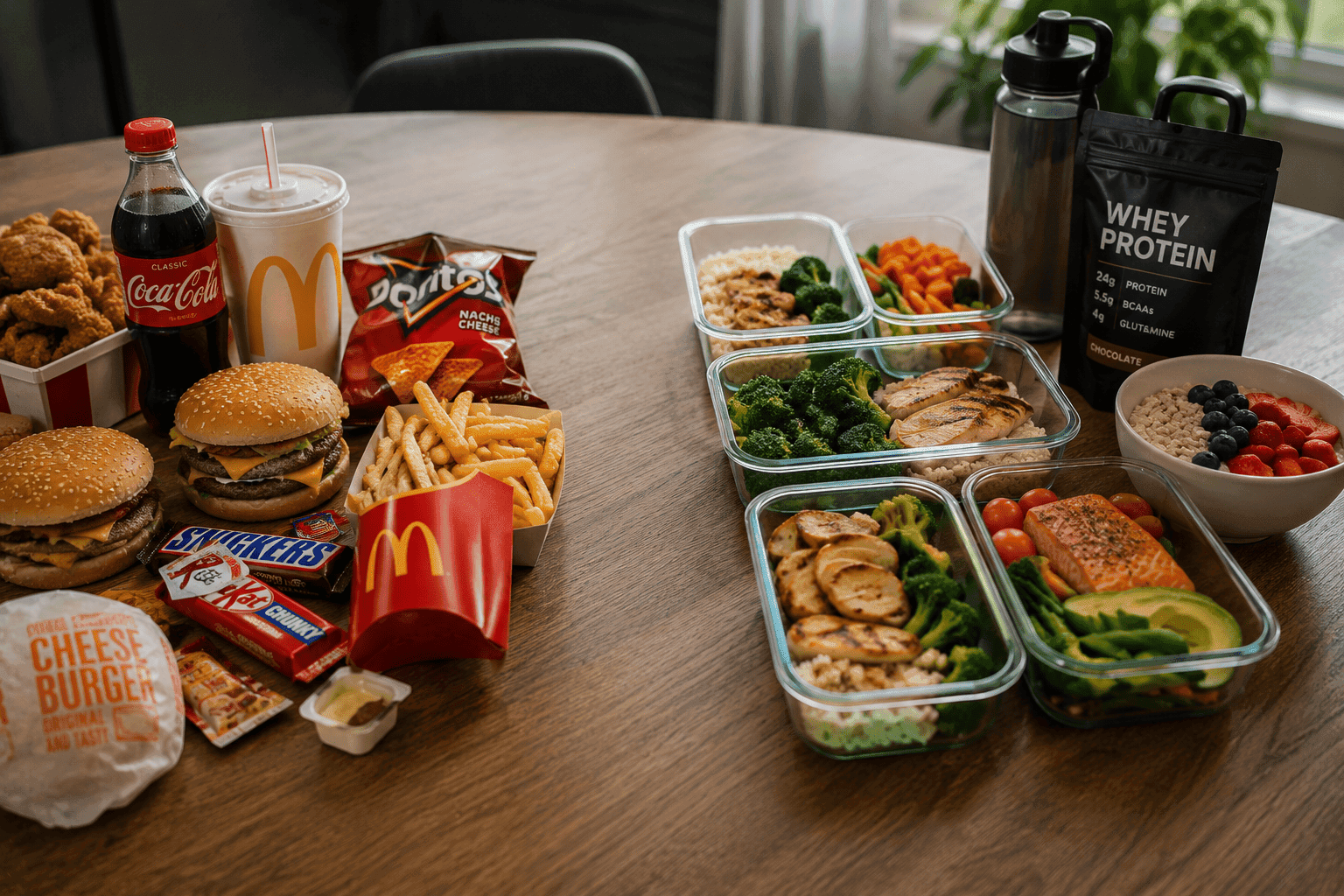
Why Modern Food Makes Healthy Eating Difficult: Navigating the Toxic Food Environment
The Modern Diet Dilemma: Why Willpower Isn't Enough
If you struggle to eat healthy, you are not alone. In fact, you are the majority. Over 70% of adults in many developed nations are now overweight or obese.
We often blame this on a "lack of willpower" or "laziness." We tell ourselves that we just need to be more disciplined. But this ignores a fundamental truth: we are living in a Toxic Food Environment.
For 99.9% of human history, food was scarce, and getting it required intense physical effort. Today, food is everywhere—it’s cheap, it’s calorie-dense, and it is scientifically engineered to be addictive. We are fighting a 21st-century food system with an ancient, Stone Age brain. In this article, we’ll explore the real reasons why modern food makes healthy eating so difficult and how you can "outsmart" the food industry to reclaim your health.
---
1. Hyper-Palatability: The Science of the "Bliss Point"
Food companies don't just "make" food; they "engineer" it. They employ teams of scientists to find the exact combination of sugar, salt, and fat that triggers the maximum dopamine release in your brain. This is known as the Bliss Point.
Hyper-palatable foods (like chips, cookies, and fast food) bypass our natural "satiety signals." Usually, when you eat, your body releases hormones like CCK and PYY that tell your brain you’re full. But hyper-palatable foods are so stimulating that they override these signals.
This leads to "Hedonic Hunger"—eating for pleasure rather than for energy. You can be physically "full" but still have a "craving" for more processed food because your brain is chasing the next dopamine hit. It’s not a lack of willpower; it’s a biological hijack.
---
2. Ultra-Processed Foods (UPF): The Silent Health Eroders
A growing body of research is focusing on Ultra-Processed Foods. These are products that contain ingredients you wouldn't find in a home kitchen—emulsifiers, stabilizers, artificial flavorings, and highly refined oils.
UPFs now account for more than half of the average person's diet. The problem isn't just the calories; it’s the structure of the food. UPFs are "pre-digested." Because they are so refined, your body absorbs the calories almost instantly, leading to massive insulin spikes and very little "thermic effect of food" (the energy your body uses to digest food).
Furthermore, UPFs are often devoid of fiber, which is essential for gut health and satiety. Eating UPFs is like putting "jet fuel" into a "diesel engine"—it causes inflammation, metabolic stress, and chronic hunger.
---
3. The "Vanishing Caloric Density" Myth: Why You’re Always Hungry
Have you ever noticed that you can eat an entire bag of chips or a giant tub of popcorn and still feel like you haven't eaten anything? This is "Vanishing Caloric Density."
Food engineers design snacks that "melt in your mouth," sending a signal to your brain that the calories have "vanished." This tricks your brain into thinking you are consuming fewer calories than you actually are.
Compare this to eating a steak or a bowl of broccoli. Those foods are "bulky" and require chewing. They take up space in your stomach and activate "stretch receptors" that signal fullness. Modern food is designed to be "invisible" to your satiety systems, allowing you to consume thousands of calories before your brain even realizes you’ve started eating.
---
4. Hidden Sugars and the Insulin Rollercoaster
The modern food system is marinating in sugar. It’s in our bread, our pasta sauce, our salad dressings, and our "healthy" yogurts.
When you consume refined sugar, your blood glucose spikes. Your pancreas then pumps out a massive amount of insulin to bring that glucose down. This often leads to a "sugar crash"—where your blood sugar drops below baseline.
When your blood sugar is low, your brain goes into "panic mode." It demands quick energy, which leads to intense cravings for more sugar. You are on a metabolic rollercoaster all day, constantly chasing the next "up" to avoid the "down." This makes "moderate eating" almost impossible.
---
5. Seed Oils and Systemic Inflammation
Most modern processed foods are cooked in or contain refined seed oils (like soybean, corn, and cottonseed oil). These oils are high in Omega-6 fatty acids, which, in excess, are pro-inflammatory.
While we need some Omega-6, our ancestors ate a ratio of roughly 1:1 (Omega-6 to Omega-3). The modern diet often has a ratio of 20:1. This chronic, low-grade inflammation interferes with your hormones, including leptin—the hormone that tells you to stop eating.
When your brain becomes "leptin resistant" due to inflammation, you are perpetually hungry, and your metabolism slows down. You are literally "starving in a land of plenty."
---
6. The "Health Halo" Trap: Marketing vs. Reality
The food industry is excellent at "Health Washing." They use buzzwords like "natural," "gluten-free," "low-fat," or "organic" to create a Health Halo around processed products.
People often consume more of a food if they perceive it as "healthy."
- A "vegan" cookie is still a cookie.
- "Organic" cane sugar is still sugar.
- "Low-fat" yogurt is often loaded with extra sugar to compensate for the lost flavor.
This marketing makes "healthy eating" confusing. We think we are making good choices while we are actually consuming the same processed ingredients under a different label. This is why using a [macro calculator](https://gymguide.co/macro-calculator) is so important—it allows you to see past the marketing and look at the objective data of what you are putting in your body.
---
7. How to Reclaim Your Plate in a Processed World
You cannot change the food environment, but you can change your relationship with it.
The Single-Ingredient Rule
The simplest way to avoid the traps of modern food is to eat things that have only one ingredient.
- An egg is an egg.
- Broccoli is broccoli.
- A chicken breast is a chicken breast.
If a food doesn't have a label, it’s probably good for you. If it does have a label, and that label has 20 ingredients you can't pronounce, it’s a "food-like substance," not food.
Mastering the Art of Home Cooking
Home cooking is the ultimate health "hack." When you cook your own food, you control the oils, the salt, and the sugar. You are re-connecting with the process of nourishment.
Using Data to Navigate the Abundance
In a world of infinite calories, you must be intentional.
- Use our [calorie calculator](https://gymguide.co/calorie-calculator) to understand your true energy needs.
- Use our [BMI calculator](https://gymguide.co/bmi-calculator) to monitor how your food choices are affecting your body composition over time.
- Follow a structured plan from our [exercise guide](https://gymguide.co/exercises) to ensure you are using those calories to build muscle and health.
---
Conclusion: The Rebellious Act of Eating Real Food
In the modern world, eating "normally" will make you sick. The "normal" diet is one of ultra-processed convenience, chronic inflammation, and metabolic dysfunction.
Choosing to eat real, whole foods is a rebellious act. It requires you to swim against the current of a billion-dollar food industry. It requires you to prioritize your long-term health over short-term "bliss points."
But the reward is worth it. When you stop eating "engineered" food, your taste buds recover. Real food starts to taste better. Your energy stabilizes, your brain fog clears, and your body finally begins to reflect the hard work you put in at the gym. Stop being a customer of the processed food industry and start being a steward of your own biology.
---
Frequently Asked Questions (FAQ)
1. Is "processed food" always bad?
No. Processing can be as simple as freezing or canning. "Processed" is a spectrum. Frozen spinach is processed but healthy. A frozen pizza is "ultra-processed" and problematic. Focus on avoiding the "ultra" side of the spectrum.
2. How can I stop cravings for junk food?
The best way is to "crowd out" the junk. Prioritize protein and fiber (from whole foods) at every meal. When you are truly nourished, your brain’s "emergency" hunger signals will quiet down. Use our [macro calculator](https://gymguide.co/macro-calculator) to ensure you're getting enough protein.
3. Why is healthy food more expensive?
This is a complex issue of subsidies and scale. Processed foods (corn, soy, wheat) are heavily subsidized, making them artificially cheap. However, when you factor in the long-term "costs" of healthcare, whole foods are much cheaper. Focus on "staples" like eggs, beans, rice, and frozen vegetables to save money.
4. Can I still eat out and be healthy?
Yes, but you have to be vigilant. Most restaurants use cheap seed oils and add sugar to everything. Look for "simple" preparations like grilled meats and steamed vegetables. Avoid "sauce-heavy" dishes.
5. What should I do if I "slip up" and eat junk food?
Don't panic. One meal doesn't ruin your health, just like one workout doesn't make you fit. The problem is the "guilt cycle" that leads to more emotional eating. Acknowledge it, learn from what triggered it, and get back to your "Single-Ingredient" rule at the next meal.
---
Related Posts:- [How Modern Lifestyles Are Destroying Physical Health](/blog/how-modern-lifestyles-are-destroying-physical-health)
- [Why Most Diets Fail Long-Term](/blog/why-most-diets-fail-long-term)
- [The Psychology Behind Emotional Eating](/blog/the-psychology-behind-emotional-eating)
🚀 Ready to start your transformation?
Download GymGuide Free →